[CCP Devblog] More Deployables from Super Friends
Okay, ich hab mir das jetzt mal angeschaut. Sipons hin oder her, was jetzt interessiert ist das ESS, das jetzt auf SiSi getestet werden kann und mit Rubicon 1.1 Ende des Monats zur Verfügung stehen soll. Die Abkürzung steht für „Encounter Surveillance System“ und es handelt sich um eine neue persönliche Struktur, die man mehrere hundert Kilometer abseits von Stargates, Stationen und anderen Strukturen aufstellen kann. Das Modul wird auf Nullsec beschränkt sein. Alle Auszahlungen von Nullsec-Anomalien werden auf 95 % reduziert. Wenn man im System ein ESS aufstellt, dann reduzieren sich die Auszahlungen auf 80 %. Die fehlenden 20 % werden vom ESS gesammelt. Je länger das ESS verankert ist, desto mehr steigt dieser Prozentsatz, bis hin zu 25 %. Das heißt irgendwann generieren die Anomalien dank ESS 105 % der Kopfgelder.
Rund um das ESS ist eine Bubble mit 15 km Radius. JEDER der zu dem ESS warpt, kann das Modul aktivieren. Nach 20 Sekunden bekommt er einen Requester angezeigt. In diesem Requester kann er jetzt wählen: Entweder aktiviert er die Auszahlung der gespeicherten Kopfgelder, und zwar proportional an diejenigen, die seit der letzten Auszahlung im System gerattet haben. Wenn Tahnil 50 % der gespeicherten Kopfgelder verursacht hat, Edward 30 % und Arthasis 20 %, dann bekommen diese drei Piloten genau ihren rechtmäßigen Anteil. Und zwar direkt auf das eigene, private Konto überwiesen.
Aber es gibt noch einen zweiten Knopf. Wenn der Benutzer diesen aktiviert, dann gibt es keine Auszahlung an die Ratter, sondern dann druckt das ESS „Tags“ (ähnlich wie das blaue Loot in Sleeper Sites) im Wert der gesamten gespeicherten Kopfgelder des ESS. Diese Tags sind nach 40 Sekunden fertig und werden vom ESS ausgespuckt. Man kann diese Items dann in den Laderaum seines Schiffs packen, aus der Bubble fliegen und wegwarpen.
Wichtig ist noch zu wissen, dass das ESS wie ein Cyno auf dem Overview erscheint. Jeder sieht es sofort beim Betreten eines Systems und kann sofort hinwarpen. Außerdem gibt es eine sonnensystemweite Nachricht an alle, sobald jemand seinen Warp auf das ESS eingeleitet hat. Man sieht dann auch den Namen des Piloten, der auf das ESS warpen will.
Soviel dazu.
Ich habe gerade auf TheMittani.com gelesen. Das Feedback ist dort überwiegend negativ. Es wurden auch schon mehrere Aspekte angesprochen, die an dem Konzept problematisch erscheinen:
– Die Ratter könnten einen n00b-Alt an das ESS stellen, während sie ratten. Sobald Neutrale das System betreten, warpen alle aus den Anomalien (wie bisher, das ist Standard) und der n00b-Alt drück den „Share“-Button. Heißt: es werden keine Tags generiert, das Geld fließt sofort auf das Konto der Ratter. Die Neutralen können am ESS dann höchstens noch den n00b-Alt abknallen, sowie das ESS selbst. Da das ESS wohl ca. 30 Mio ISK kosten wird, hält sich der Verlust für die Ratter in Grenzen, wenn das nur alle paar Tage passiert, oder erst nach Stunden des Rattens.
– Das ESS wird von einigen kritisch gesehen, weil es eine neue Form des AWOXings („Kriminalität“ innerhalb von Corporations und Allianzen) ermöglicht. Man kann mit einem beliebigen Alt die Ratter der eigenen Corp oder Allianz bescheißen.
– Die Timer werden von einigen als viel zu kurz kritisiert. Es wäre nicht genug Zeit für die Bewohner des Systems, eine Verteidigung zu organisieren, wenn Neutralos das ESS anwarpen, um es auszurauben.
– Interceptors und Nullified T3 können einfach direkt zu dem ESS warpen und wieder wegwarpen, was das Zeitfenster für die Abwehr noch mehr verkleinert. So kann man sich kaum noch wehren.
– Roaming Gangs und Neutralos könnten das ESS zum griefen einsetzen, selbst wenn es in einem System gar keines gibt. Einfach in einem Ratting-System aufstellen, Tackler zurücklassen und abwarten. (Dieses Argument finde ich von allen vielleicht am schwächsten. Die Ratter werden eh nix machen, wenn Feinde im System sind, dafür braucht es kein ESS, das noch dazu 30 Mio kostet und transportiert werden muss.)
Ich habe mir noch kein abschließendes Urteil gebildet, aber der erste Punkt, den ich da genannt habe, ist für mich eigentlich schon direkt wieder ein Showstopper. Mit diesem n00b-Alt können Ratter im Grunde das Risiko ausschalten. Was bleibt ist dann einfach nur, dass PvE um einen lästigen Schritt erweitert und es keine neuen Konflikte geben wird. Diesen Punkt muss sich CCP noch einmal genauer anschauen.
Ich erinnere mich, dass wir vor Wochen oder Monaten mal im TS über einen ähnlichen Spielmechanismus gesprochen haben. Da hatte ich mir vorgestellt, dass ein Teil der Kopfgelder automatisch im Infrastructure Hub zwischengespeichert werden, und dass Roamer und Angreifer die Möglichkeit haben dorthin zu fliegen und das Hub zu hacken, um Geld abzuzapfen. Allerdings fände ich es irgendwie geiler, wenn man nicht auf einen Schlag das Geld bekommen würde, sondern wenn das wie an einer Tankstelle funktionieren würde. Heißt: solange ich an dem Hub stehe und „hacke“ zapfe ich einen stetigen Strom von ISK ab. Man bekäme dann beispielsweise alle fünf oder zehn Sekunden eine Überweisung. Das ist einerseits viel besser zum Baiten geeignet, weil der Schmerzpegel bei den potenziellen Verteidigern steigt, andererseits haben die Verteidiger so eine richtige Chance eine Gegenflotte zu bauen. Meinetwegen kann das Abzapfen auch mit diesen Tags funktionieren, denn somit hätten die Verteidiger die Chance einen Teil ihres Geldes durch Zerstören des Angreifers zurück zu erhalten, und das Geld ist nicht einfach nur sofort weg!
Ich denke CCP muss sich die Mechanik noch einmal genau anschauen. Es ist auch nicht verständlich, warum sie für diese neue Mechanik nicht das Hacking-Mini-Game verwenden. Warum nur? Das ist doch wie dafür gemacht!
Re: [CCP Devblog] More Deployables from Super Friends
« Antwort #1 am: Januar 15, 2014, 11:56:18 Vormittag »
Warum wurden die Strukturen „Mobile Micro Jump Unit“ und „Mobile Scan Inhibitor“ eigentlich erst ganz vorsichtig in einem „Features & Ideas“ Beitrag angekündigt und inzwischen auch aufgrund von Spieler-Feedback angepasst / überarbeitet, während das ESS sofort in einem triumphalen Dev Blog beschrieben wird? Ich denke es gibt viele gute Verbesserungsvorschläge und auch sehr gute Einwände gegen die derzeitige Ausgestaltung des ESS.
Re: [CCP Devblog] More Deployables from Super Friends
« Antwort #2 am: Januar 15, 2014, 01:19:30 Nachmittag »
Okay, meine Meinung steht. Das ESS ist einfach ein 5-%-Buff für Nullsec-Ratter. Sie werden einen Alt daneben stellen und den Button drücken, sobald ein Fremder im Local auftaucht. Bedeutet ein beinahe risikoloses Extra-Einkommen.
Vielleicht dreht CCP daran noch etwas, aber so sieht‘s im Moment für mich aus.
Umso blöder erscheint mir gerade das Geheule im Forum und auf TMC. Das erscheint mir ähnlich wie bei den Änderungen an Maraudern, wo die eingefahrenen, phantasielosen und abgestumpften Mission Runner gar nicht gemerkt haben, dass die neuen Marauder einen Mega-Buff für Mission Running darstellen. Die sind für PvE um Längen besser geworden durch diese Änderungen. Aber Hauptsache erst einmal herumheulen.

[CCP Devblog] More Deployables from Super Friends
« Antwort #3 am: Januar 15, 2014, 05:01:32 Nachmittag »
More Deployables from Super Friends
<p>
Hello Capsuleers! This is CCP SoniClover fresh from my holiday hibernation to tell you all about what shenanigans Team Super Friends is up to for the Rubicon point release due at the end of January.</p>
<p>
What you will see from us in 1.1 can be neatly divided into two parts – couple of variations of siphon units on one hand and a new deployable called Encounter Surveillance System on the other.</p>
<h3>
<strong>Put the Siphon</strong></h3>
<p>
Let’s start with the siphon variations. There are two of them, both also small like the one released in Rubicon.</p>
<p>
<a rel="nofollow" target="_blank" href="http://content.eveonline.com/www/newssystem/media/65631/1/Siphon_Rote.jpg"><img alt="" src="http://content.eveonline.com/www/newssystem/media/65631/1/Siphon_Rote_550.jpg" style="width:550px;height:246px;"/>[/url]</p>
<p>
The Small Mobile ‘Rote’ Siphon Unit steals the same type of material as the base version from Rubicon. But instead of favoring raw materials over processed materials, the Rote will favor processed materials. This means it steals more of processed materials and if it can steal either raw material or simple processed materials, it will choose to steal the processed materials. As for the base version, Alchemy output is not stolen. Here are the most pertinent stats:</p>
<p>
Processed materials siphon amount: 110 units
Raw material siphon amount: 20 units
Waste factor: 10%
Capacity: 1000
The build cost of this unit is slightly higher than for the base version.</p>
<p>
<a rel="nofollow" target="_blank" href="http://content.eveonline.com/www/newssystem/media/65631/1/Siphon_Hybrid.jpg"><img alt="" src="http://content.eveonline.com/www/newssystem/media/65631/1/Siphon_Hybrid_550.jpg" style="width:550px;height:246px;"/>[/url]</p>
<p>
The Small Mobile ‘Hybrid’ Siphon Unit steals polymers (from Polymer Reactor Arrays). It does not steal Fullerenes directly. The batch sizes of the polymers vary a lot (currently ranging from 2 to 1000). This huge range makes it difficult to work with. As there is really no reason for this great of a range, as part of introducing the Hybrid Siphon Unit, we’re adjusting the batch sizes for polymers a bit. More on that below, lets first look at the most pertinent stats:</p>
<p>
Polymer siphon amount: 50% of batch size (we’re using percentages here because of the size variation differences)
Waste factor: 10%
Capacity: 1200
The build cost is the same as the base version.</p>
<p>
A bit more on the batch sizes. We’re increasing the batch size for the smallest ones, so they all have a batch size of at least 100. We’re adjusting volume and blueprint material requirements accordingly so that the end result remains the same (i.e. each batch takes the same size as before and building requirements require the same amount of polymers proportionally). Furthermore, we will run update scripts to update all current stockpiles of polymers when the changes go live. This includes all inventories, as well as buy and sell orders and contracts. This means that players will retain the correct ratio of polymers.</p>
<h3>
<strong>Money for Pirates, ISK for Free</strong></h3>
<p>
Now for the new deployable. The collective term is Encounter Surveillance System, or ESS. Let's start with a quick tl;dr version, refer to the rest of the text for further details. After 1.1, players receive 95% of a bounty income in Null Sec. An active ESS in a system changes the direct payout value to 80%, but further 20% is stored in a system-wide pool that can be accessed through the ESS. This additional bounty payment can rise to 25% over time. So post-1.1, players have the choice to either skip using an ESS and get 95% bounty value, or use ESS and generate 100% up to 105% of bounty value, but have a portion of it be at risk.</p>
<p>
<a rel="nofollow" target="_blank" href="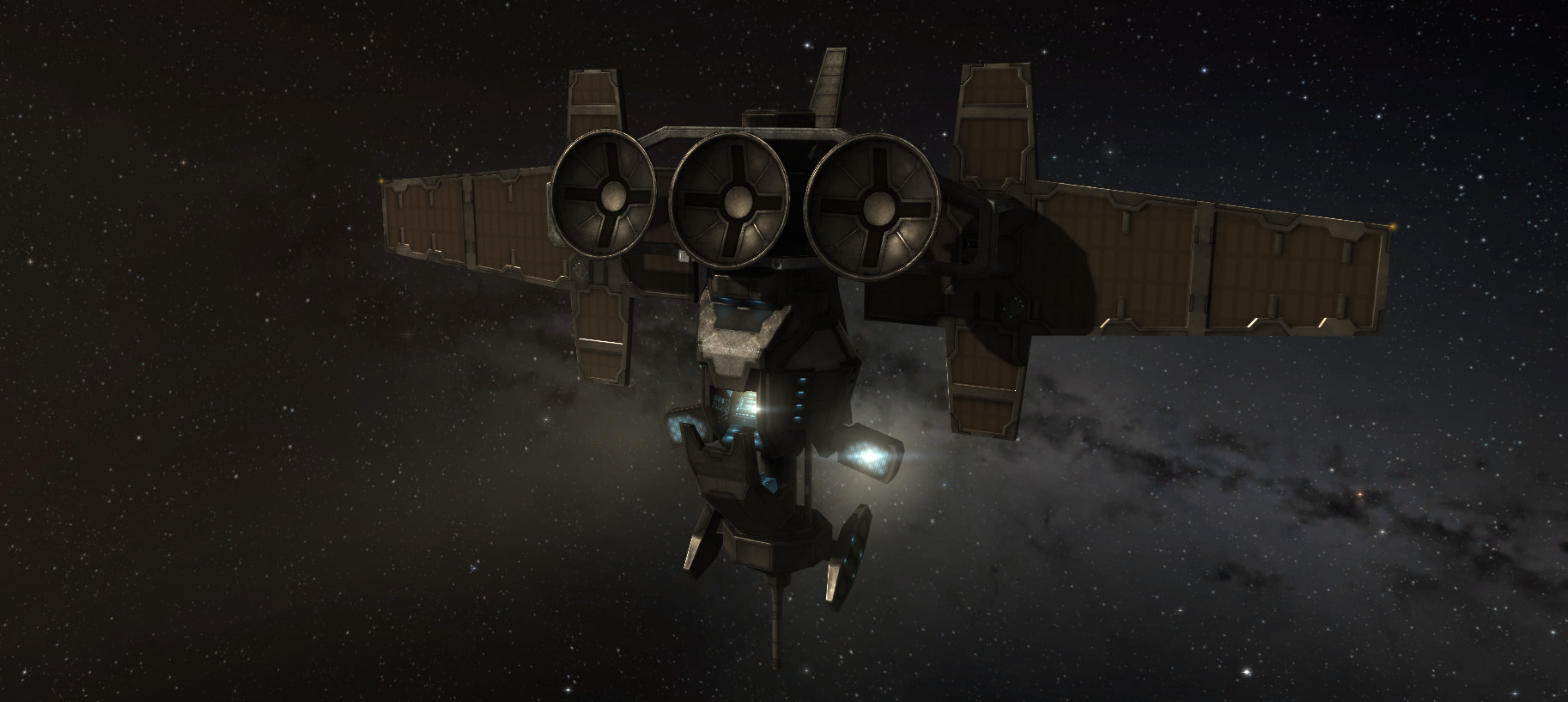 "><img alt="" src="http://content.eveonline.com/www/newssystem/media/65631/1/AmarrEncounterSurveillanceSystem_550.jpg" style="width:550px;height:246px;"/>[/url]</p>
<p>
Each race has their own ESS, so there are four in total, Amarr/Caldari/Gallente/Minmatar Encounter Surveillance System. An ESS allows an empire to monitor bounty-generating activities in the solar system it is deployed in. Why this is a thing is due to an on-going and ever-growing feud between the empires and Concord. Concord has decided that monitoring these bounty-generating activities (i.e. killing pirates) outside of their jurisdiction is becoming too expensive, especially with the lost income from high-sec Custom Offices. As a result, they will no longer pay the full bounty amount. There is no statistical difference between the racial variants</p>
<p>
<strong>After Rubicon 1.1 the payout for killing pirates in Null Sec is 95% of the actual bounty.</strong> So a pirate with a bounty of 100.000 ISK will give whomever killed it 95.000 ISK after the point release.</p>
<p>
Deploying an ESS in a system affects the payout. With an active ESS, the base payout (what you get directly into your wallet) is reduced further, down to 80% of actual bounty value. This is because Concord doesn’t like it when somebody starts interfering with their bounty activity monitoring.</p>
<p>
But what happens also is that the ESS starts computing bounty payouts. This is set to 20% of the actual bounty value. This means that with an active ESS in a system, the total bounty payouts are 100%, or equal to the value players receive today. The main difference is that part of it is only accessible through the ESS and does not go directly to the player. The ESS represents empire monitoring efforts that allow them to compensate players to offset the reduced value that Concord is paying out.</p>
<p>
The longer an ESS is active in a system, its payout value increases over time and can rise from 20% to 25%. This addition comes on top of the other payments, i.e. the base 80% payment remains the same. This means that with a fully increased ESS, the total payment is 105% of the actual bounty value. Note that this increase only applies to bounties generated after the increase has occured. Also, the increase in payout level is based on bounty-generating activity, so the payout level will not rise for an active ESS if there is no bounties being generated in the system.</p>
<p>
The value the ESS tracks creates a system-wide pool. This is a common pool for all bounties generated in the system, there is not a separate pool for each player.</p>
<p>
This pool can only be accessed through the ESS. Accessing the ESS is a timed action that takes 20 seconds to complete. Only one player can access the ESS at a time and the access range is 2500 meters. Once a player has accessed the ESS, a window opens up where the player has two choices, Share and Take all. <strong>Anyone can access the ESS. </strong>The ESS cannot be accessed while cloaked.</p>
<p>
The<strong> Share</strong> option will share the contents of the pool amongst those that have contributed to the pool. Each player then gets his own contribution back. Choosing this option is effectively confirming the monitoring efforts of the ESS as correct, allowing the empires to transfer ISK directly to the contributing players. This ISK is transferred even if the contributing player has left the system or is offline.</p>
<p>
The <strong>Take all</strong> option will give the total contents of the pool to the player accessing the ESS. Choosing this option is effectively telling the ESS its computations are incorrect and the player will take on the responsibility of dividing the ISK correctly. At least, that’s what the empires, in their infinite wisdom, are assuming that the law-abiding pilots of New Eden will do. The ESS hands out the value of the pool in the form of ISK tags. See more below in ISK tags. It takes time for the ESS to print the tags and hand them out, this time is 40 seconds.</p>
<p>
Here is an early version of the window:</p>
<p>
<img alt="" src="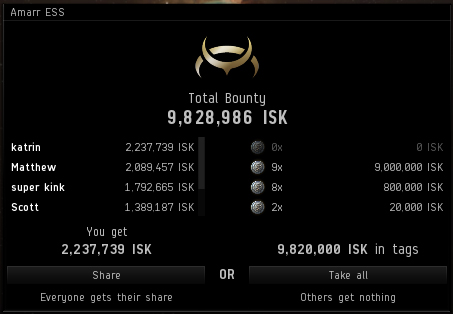 " style="width:453px;height:314px;"/></p>
<p>
The choice thus for players is either to skip deploying an ESS, receiving 95% of the bounty value, but getting it all directly to wallet. Or they can deploy an ESS, generating at least full bounty value and even more over time, but with a portion of the bounty value being at risk of being stolen.</p>
<h3>
<strong>Facts and Figures</strong></h3>
<p>
Let’s try to cover some of the further aspects of the ESS in a bullet-point list (plus some repeats):</p>
<ul>
<li>
Encounter Surveillance Systems are sold directly from the navies of the empires. For instance, the Gallente ESS is sold in Federation Navy stations. The retail price is around 30 million. Stat wise, all the ESS structures are identical. The only difference is what kind of ISK tags they drop (see more below on ISK tags).</li>
<li>
Only one ESS can be active in a system at any given time.</li>
<li>
An ESS cannot be deployed close to stations, stargates or starbases. The minimum range from these structures is several 100 kilometers.</li>
<li>
An ESS can only be deployed in Null Sec.</li>
<li>
It takes 60 seconds for a deployed ESS to become active. As with the other mobile structures, the anchoring and onlining is a single action.</li>
<li>
The ESS has a global beacon, meaning it will be visible by all players, allowing them to warp directly to it. Note that the new scan-block deployable does not interfer with this.</li>
<li>
The ESS has around 150.000 Hit Points (ca. 90000 structure, and 30000 each in armor and shield).</li>
<li>
The ESS can be scooped up by the owner of the ESS (the player that deployed it).</li>
<li>
Destroying or scooping the ESS will not affect the system-wide pool. That is only affected by successfully accessing the ESS and choosing to Share or Take all. The system wide-pool stays intact and becomes available again when another ESS is deployed.</li>
<li>
The payout level of an ESS is reset if it is destroyed, scooped or when it is accessed and the system-wide pool is distributed.</li>
<li>
The current payout level of the ESS is visible in the name of it, and can thus be seen anywhere in the system.</li>
<li>
The ESS has a warp bubble with a radius of 15km. Warping to the ESS brings you to the edge of the bubble. This warp bubble has exactly the same functionality as a normal one.</li>
<li>
Whenever a ship warps to the ESS, a broadcast is made in local informing everyone in the system that player X is in the vicinity of the ESS. This triggeres even if the approaching ship is cloaked.</li>
<li>
Anyone can access an ESS, not just the owner.</li>
<li>
When a player accessing an ESS has chosen whether to Share or Take all, everyone that contributed to the pool receive a notification of the choice made. This notification includes the name of the player that accessed it.</li>
</ul>
<h3>
<strong>The Bounty Reimbursement Tags</strong></h3>
<p>
When a player chooses the Take all option when accessing an ESS, that player receives the ISK in the pool in the form of tags. These tags are called Bounty Reimbursement Tags. Each empire have their own tags and the tags dropped depend on the ESS type (so the Amarr ESS will drop Amarr tags). The Bounty Reimbursement Tags have a volume of 0.01. The actual functionality is that the ESS stores blank tags and then prints tags and drops them when needed.</p>
<p>
Apart from the empire distinction, tags also come in four value variations, 10.000, 100.000, 1 million and 10 million. So the tags for Amarr, for example, are named Amarr 10K Bounty Reimbursement Tag, Amarr 100K Bounty Reimbursement Tag, Amarr 1M Bounty Reimbursement Tag and Amarr 10M Bounty Reimbursement Tag.</p>
<p>
When the Take all option is selected, the pool is divided into tags, using as few tags as possible. Remnants (i.e. whatever is left under 10K) are removed.</p>
<h3>
<strong>This is the End</strong></h3>
<p>
You can test the new siphon units and the ESS feature on SISI right now, we’d love for as many as possible to try them out and give us feedback.</p>
<p>
That’s it for Team Super Friends. Our main goal for Rubicon and its point release has been to introduce different ways for players to affect each other’s gameplay, introducing risk where there was none before, give players some interesting choices and general mayhem. We hope we’ve hit at least some of our goals, improving EVE in the process. Until next time.</p>
<p>
</p>
<p>
<span style="color:rgb(89, 89, 89);font-family:Helvetica, Arial, sans-serif;font-size:13px;">New to EVE? Start your </span><a rel="nofollow" target="_blank" href="https://www.eveonline.com/start" style="color:rgb(29, 96, 255);font-family:Helvetica, Arial, sans-serif;font-size:13px;">14-day free trial[/url]<span style="color:rgb(89, 89, 89);font-family:Helvetica, Arial, sans-serif;font-size:13px;"> today.</span><br style="color:rgb(89, 89, 89);font-family:Helvetica, Arial, sans-serif;font-size:13px;"/>
<span style="color:rgb(89, 89, 89);font-family:Helvetica, Arial, sans-serif;font-size:13px;">Returning pilot? Visit </span><a rel="nofollow" target="_blank" href="https://secure.eveonline.com/AccountManMenu.aspx?aid=112609" style="color:rgb(29, 96, 255);font-family:Helvetica, Arial, sans-serif;font-size:13px;">Account Management[/url]<span style="color:rgb(89, 89, 89);font-family:Helvetica, Arial, sans-serif;font-size:13px;"> for the latest offers and promotions</span></p>
Source: More Deployables from Super Friends
Re: [CCP Devblog] More Deployables from Super Friends
« Antwort #4 am: Januar 15, 2014, 06:02:39 Nachmittag »
Shit. Wollte eigentlich nur diese News mit drei Beiträgen von mir zu demselben Thema vereinen. BAM. Alles kapott!
Re: [CCP Devblog] More Deployables from Super Friends
« Antwort #5 am: Januar 15, 2014, 06:50:12 Nachmittag »
Terrorist!

Re: [CCP Devblog] More Deployables from Super Friends
« Antwort #6 am: Januar 20, 2014, 06:45:25 Nachmittag »
Hab jetzt mal eine Woche lang im entsprechenden Threadnought im EVE-Forum mitdiskutiert. Es bringt einfach nix. Nullbears weinen hart über den 5% Einkommensnerf, ohne den potenziellen 5% Buff zu sehen. Small-scale PvP ist denen eh völlig wurscht. Vor zwei Jahren haben noch alle über den Slogan "Farms and Fields" gejubelt. Aber wenn die erste Farm kommt, dann ist es auch nicht gut.
Re: [CCP Devblog] More Deployables from Super Friends
« Antwort #7 am: Januar 20, 2014, 06:59:18 Nachmittag »
Wat fürn Einkommensnerf. So wie das atm aussieht haben die doch garantiert 105% Bounty statt 95%, wenn die alles richtig machen.
Nen Alt neben das ESS zu stellen und auf Share klicken, wenn ein Neut in den Local kommt, kann doch nicht so schwer sein.
Meiner Meinung nach, soll CCP es den Farmern nicht so einfach machen!
Re: [CCP Devblog] More Deployables from Super Friends
« Antwort #8 am: Januar 21, 2014, 03:06:28 Nachmittag »
Aha! Es tut sich was.
https://forums.eveonline.com/default.aspx?g=posts&m=4135933#post4135933
Here's a quick update on the changes we've made to the ESS, based on testing and feedback. There is a dev blog coming out tomorrow detailing these (and other changes) to the deployables in 1.1, but here's a basic overview.
Additions/edit
* With an active ESS in system, bounties pay out LP in addition to normal ISK reward. LP reward starts at 0.15 LP per 1000 ISK and can increase to 0.2 LP per 1000 ISK as the bonus payout increases. As an example, a bounty worth 1 million ISK (total) gives between 150 and 200 LPs, based on payout level. This is to address the risk vs. reward concerns. Thanks to those that suggested using LPs instead of ISK for balance.
* There is now no timer to open the ESS window where the player gets to choose to Share or Take all, but both options now have separate timers on them. Share has 20 seconds, Take all has 180 seconds. Moving out of range while the timer is ongoing resets the timer. This is to reduce the feasibility of having an alt sit at the ESS and quickly empty the pool when someone shows up.
* Interacting with the ESS now puts a warp disruption effect on the ship interacting with it. Ships immune to bubbles are not immune to this effect. This is to reduce the feasibility of using ships immune to bubbles for stealing purposes.
Also, some of the stats have changed:
* Price lowered from 30 million to 25 million
* Hit points increased from 150k to 250k
* Volume increased from 150 to 200
* Increased minimum range from stargates/stations to 3000 km, from 300.
* Activation time increased to 120 seconds, up from 60 seconds
Some of these changes are already out on Sisi, the rest should be there soon. Thank you all for your feedback.
Später hat CCP SoniClover noch hinzugefügt, dass dieses Modul Loyalty Points der jeweiligen Empire Navy vergibt. Ein Amarr ESS gibt also Amarr Navy LP, etc.pp.
Heißt: spätestens damit handelt es sich um einen ziemlichen Buff für Nullsec Ratting! Es ist allerdings auch damit zu rechnen, dass dies Einfluss auf die Preise in den Navy LP Stores haben wird. Wer größere Mengen von [irgendwas] Navy Issue im Hangar hat, sollte sich überlegen die jetzt erst einmal zu verkaufen, bis die entsprechenden Hisec Mission Runner sich neue LP Stores gesucht haben

Auf der anderen Seite wird das vielleicht auch nur dazu führen, dass mehr Navy Schiffe in den Nullsec-Konflikten eingesetzt werden. Da gab es ja früher vor allem Nachschubprobleme, weil nicht genug LP generiert wurden, um eine versenkte 250-Mann-Apoc-Navy-Flotte zu ersetzen.